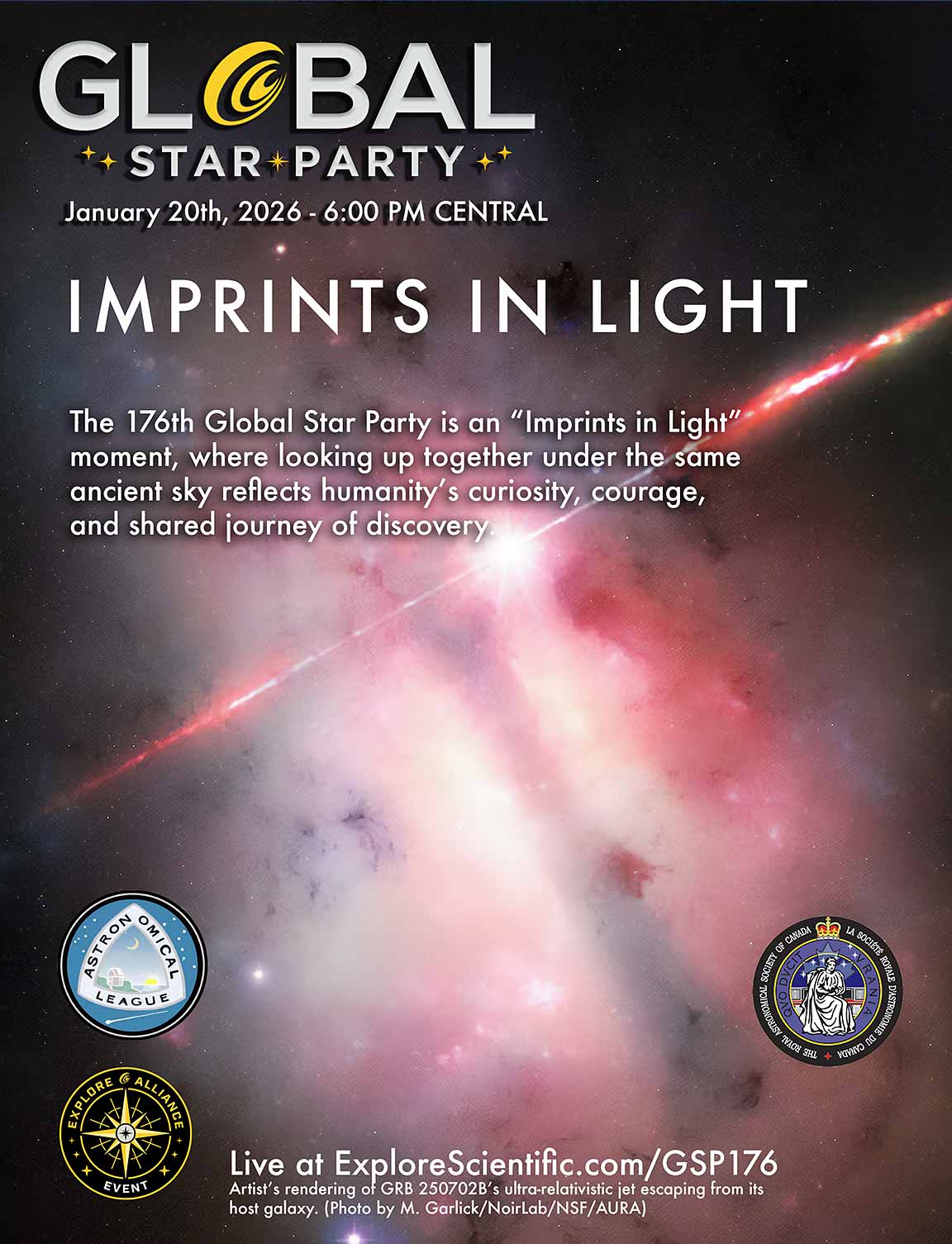
The Global Star Party is a creation of some of the most active and accomplished amateur and amateur/professional astronomers in the world. Each month they identify speakers who will give presentations of some of the most interesting and important astronomical discoveries and activities of interest to the astronomy enthusiasts of the world. The GSP is conducted online, live simulcast on YouTube, and past episodes are stored online as well.
This week, I've been invited to tell the story and background of the discovery of mine and my team, on June 25, 2025 of a new moon orbiting the distant Kuiper Belt Object Quaoar, which is one of the most intensely studied and interesting objects currently in the solar system. It has 2 newly discovered rings which theory says should not be stable and should not be there. It has a known moon, Weywot, and now, thanks to a discovery by me and my former student Kirk Bender using the big telescopes on the mountain at the Monterey Institute for Research in Astronomy, it has now a second moon. The interaction of these two moons and the two rings are an area of active research by professional astronomers and the Big Scopes in Hawaii and elsewhere to figure out why and how these rings can exist beyond the Roche Limit, where rings are supposed to be impossible.
I've been using a growing small group of students and former students to advance the accomplishements in Occultation Astronomy, and me and my group has discovered 2 moons now; a new one around the Quaoar, and in 2024, a moon around asteroid Martschmidt, in addition to providing the first confirmation of a moon around an asteroid - Arecibo in 2021 - via the occultation method.
This Global Star Party will include my telling of the story of the Kuiper Belt and how we introduced students to professional astronomers and got time on the MIRA OOS big telescope on Chews Ridge in the Big Sur Mountains, to get data on an expected occultation of a star by the ring Q1R orbiting Quaoar, and in addition, discovered a new moon. We used recording equipment within the budget of amateur astronomers and hope to inspire other amateur astronomers into this important field where amateurs can help professionals refine the orbits and characteristics of asteroids and distant Kuiper Belt Objects in our solar system. My data page for this discovery is available to students and everyone. The discovery was published (Nolthenius et al. 2025) in the professional journal "The Research Notes of the American Astronomical Society", and a follow up paper with a co-author of mine (Proudfoot et. al. 2025) in the "Astrophysical Journal Letters", and accounts are now in numerous popular science publications, all linked at the bottom of the discovery data page linked above.
PDF of PowerPoint Presentation
Live YouTube Simulcast . And ExploreScientific's website Link is here