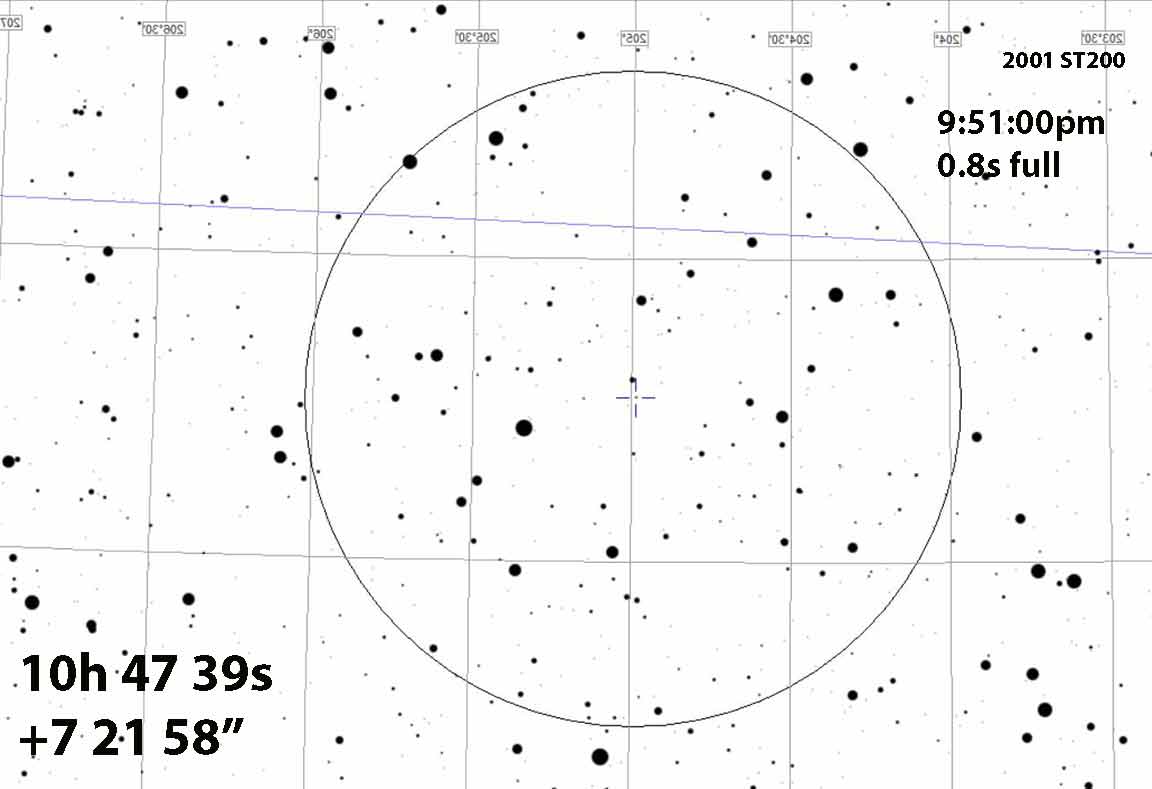
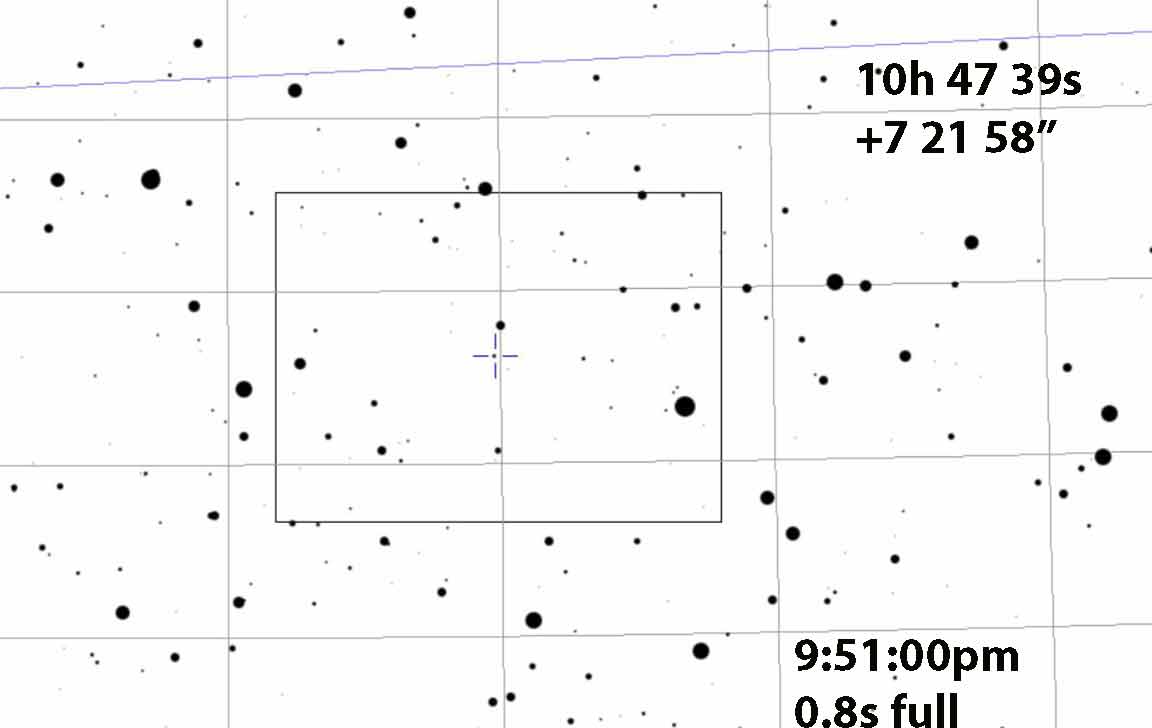
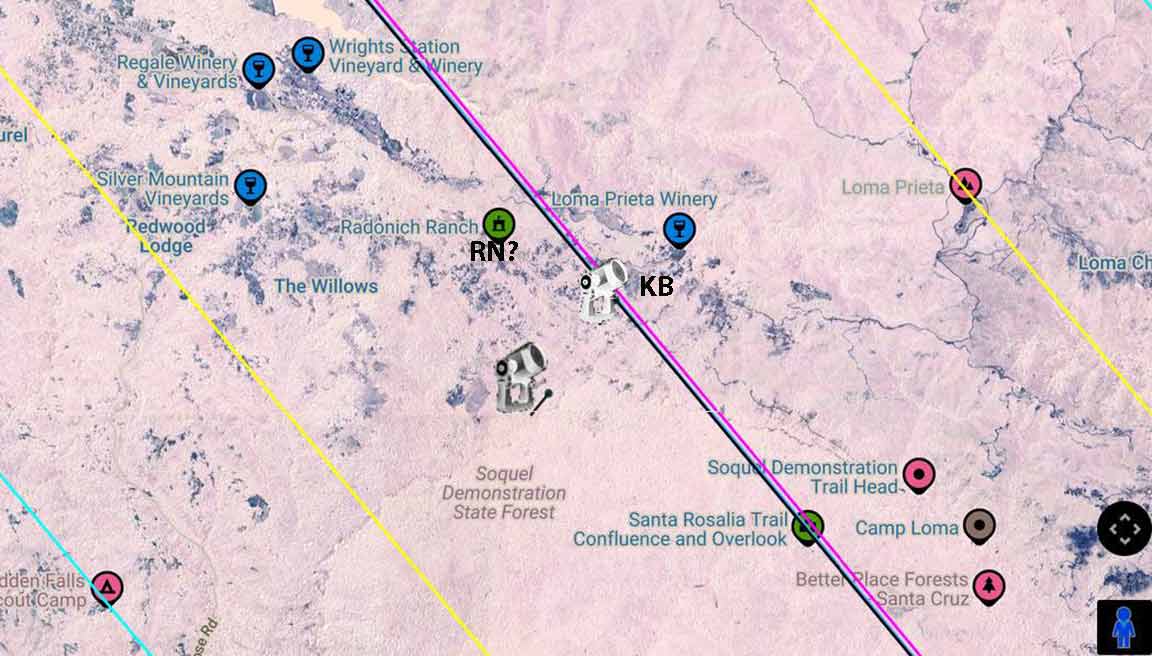
This is a faint, difficult event. But goes centrally over Karl's place on a weekend night. It lasts a decent 0.8s. If skies are clean, as they are predicted to be - it should be doable if the path is good. Hoping for a "movie night" combo at Karl's.
Alt=56, Az=212 high in the SW in southern Leo, 16 degrees due left of Regulus. The 98% moon is 54 degrees away, in the east.
|
|
|
Kirk, Karl and I converged on the centerline of this difficult event, which went right through Karl's front yard. Our goal was of course to get the event, but also to do a side-by-side comparison of the new Astrid system, used by Kirk, and my Watec 910hx PAL camera at the same cadence. I used 8x or 6.24 fps, and Kirk on the Astrid used 6 fps. Karl used his standard set up, with Startech cable and f/6.3 reducer. I was 10 feet NE of Kirk, and 20 ft east of Karl. Far enough that our "seeing event" correlation should be essentially zero; ie these distances were bigger than the expected correlated twinkling.
Since the total duration was expected to be only 0.8s, I decided to use 8x setting instead of the more comfortably visible 16x. Karl used 16x. I had a detection using min=2, max=5 integrations. But it wasn't super impressive. And it was 4 seconds early. The NIE peaks were separated by 4.1 sigma, which is decently above 2. But there were another half dozen single integrations which reached almost as deep but were only a single integration. I'm awaiting Kirk and Karl's results. Visually, watching on Karl's video recording right after the event, it looked like there was a noisy event lasting under a second; 2 integrations, with a small second drop to near zero a fraction of a second later. There is not hint of a second drop in my own record. Also, my recollection was that Karl's dip(s) were at the predicted time, not 4 sec early. I'll await their reductions before making any judgments.
The event below, says Kirk's data, is not a true event. The star did not disappear for him.
magDrop report: percentDrop: 75.1 magDrop: 1.511 +/- 0.039 (0.95 ci)
DNR: 2.44
D time: [04:50:55.5251]
D: 0.6800 containment intervals: {+/- 0.0305} seconds
D: 0.9500 containment intervals: {+/- 0.0755} seconds
D: 0.9973 containment intervals: {+/- 0.1468} seconds
R time: [04:50:55.8451]
R: 0.6800 containment intervals: {+/- 0.0305} seconds
R: 0.9500 containment intervals: {+/- 0.0755} seconds
R: 0.9973 containment intervals: {+/- 0.1468} seconds
Duration (R - D): 0.3200 seconds
Duration: 0.6800 containment intervals: {+/- 0.0422} seconds
Duration: 0.9500 containment intervals: {+/- 0.0979} seconds
Duration: 0.9973 containment intervals: {+/- 0.1716} seconds
 |
 |
 |
 |
 |
 |
 |
No detectable event. Used the Astrid system, which is slightly less sensitive than the Watec. My question would be - did he see the star during the possible early event that PyOTE found in my data? If so, then we have a conclusive miss for all 3 of us. The light curves below do look to show that there's no event at the time of my "event" 5 sec before the predicted event time.
 |
 |
 |
Star remains visible; No event at or near the event time. A miss. Therefore, we all recorded a miss. Kirk used the Astrid, different thatn the Watec. . |
RN: Karl had two closely spaced periods when the star was not visible, and detectable by PyOTE. This detection below surrounds both places. However, in my (RN's) data, there is no loss of the star, so this must be just a slight under-brightness from Karl's gear and can't be a true occultation. A missing visibility for a faint star in a bright sky might not be an occultation, but a visible star is a sure conclusion of no occultation.
