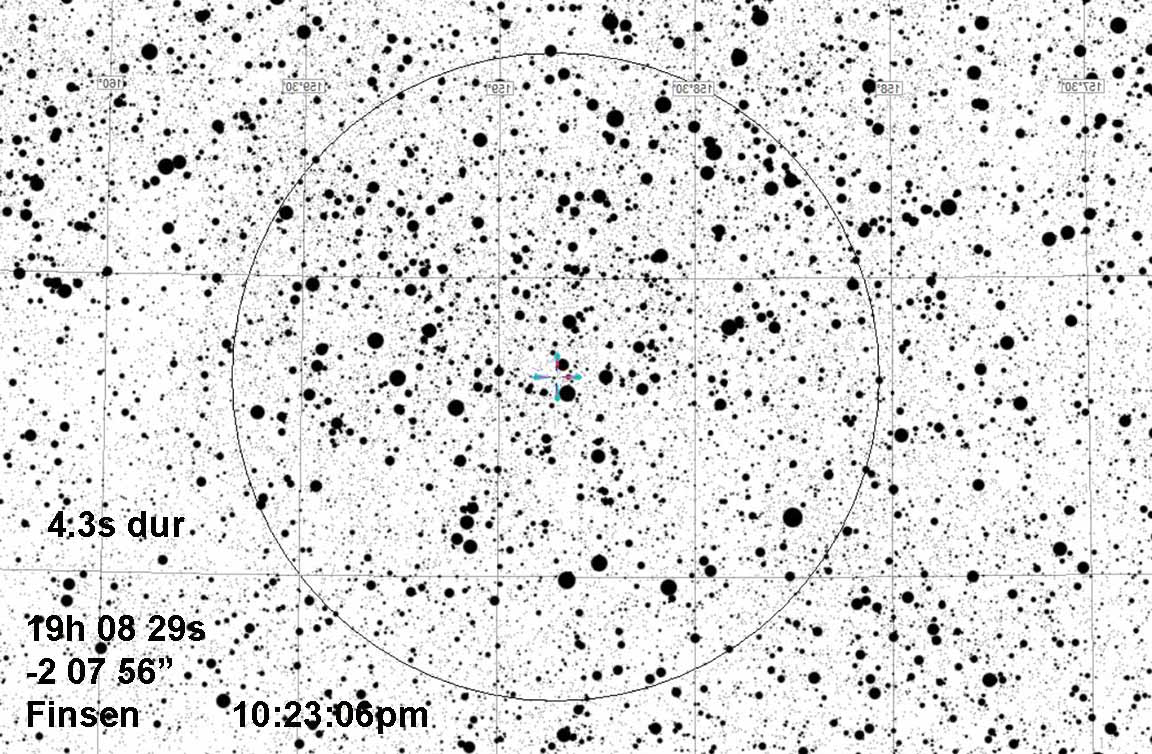
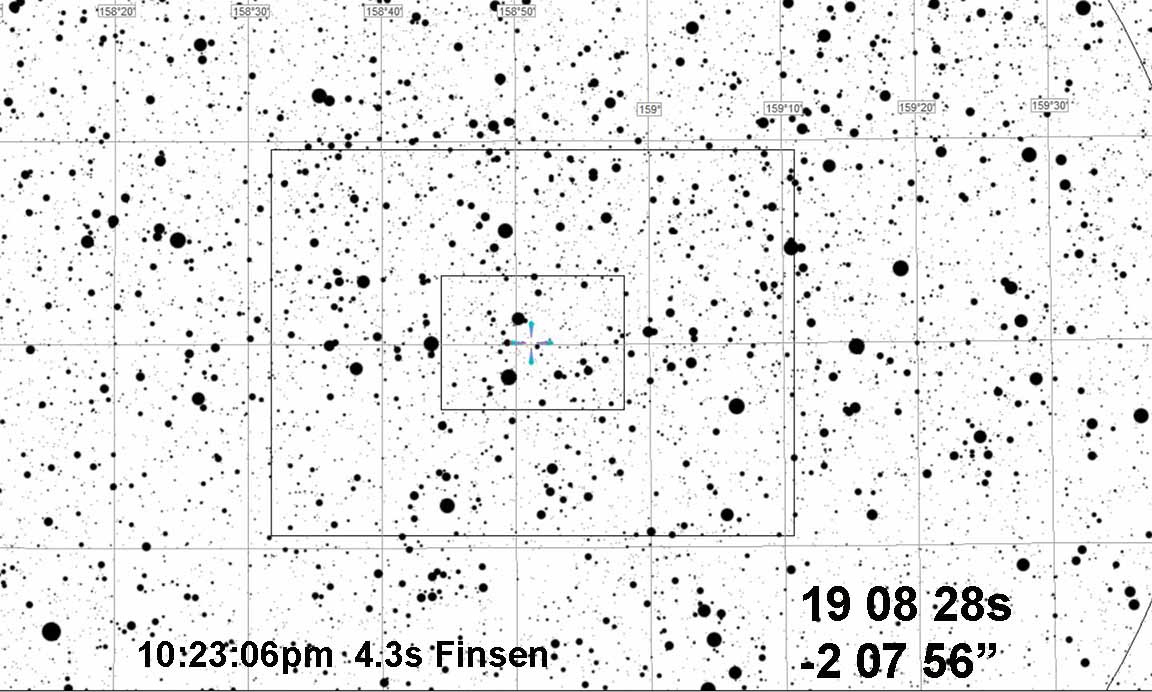
This is a very red star, and that may make for a harder to determine W magnitude (Watec 910hx magnitude). 12.6 would be quite easy for this duration. My limited past experience says it may not look quite that bright. But certainly better than the listed C2A magnitude of 15.6. Maybe 13? But at 4.3s duration and high rank, it should be quite do-able still. In heavy star field in Aquila in Milky Way.
Alt=50, Az=156 in Aquila
|
|
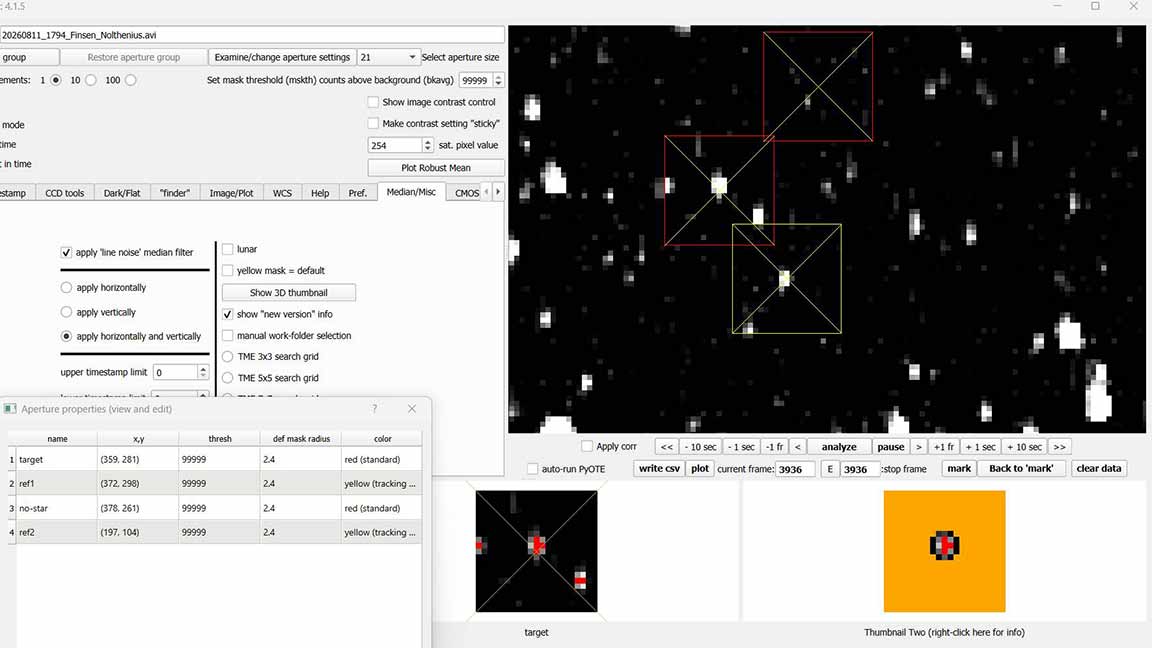
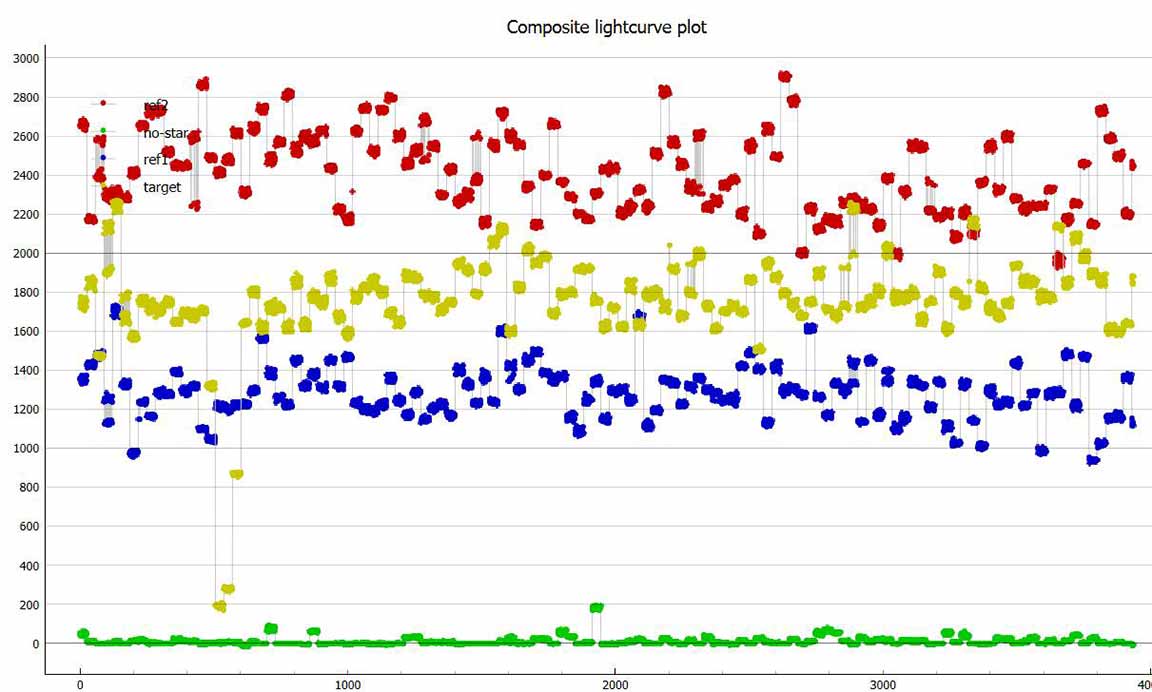
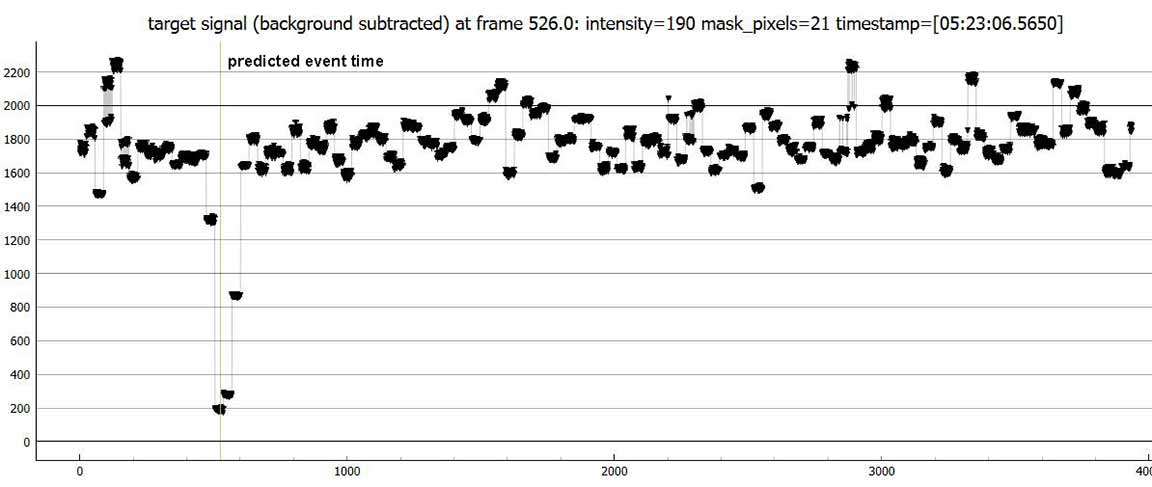
Weather was good as long as you climbed above the marine layer. I drove up to Twin Gates, on the west side. Got on target pretty easily. But the star brightnesses of so many of the stars differed from that implied by the star sizes in C2A, that I could not decide which if any of the stars I was seeing close to the target area were actually the target star. Since the B magnitude was so faint, and because it is listed as a variable star in AAVSO, I worried the star was much fainter than the W calculation above, and cranked up the integration all the way to 64x. In fact one of the easier stars to see was the target. The result is I got poor time resolution and also had saturated pixels on all of the separate integrations, for the target. The ref star wasn't that much dimmer, and had no saturated pixels, and so I think the photometry isn't badly affected by the saturated pixels. We'll see how it compares to Kirk Bender's, who was at "the Berm" just a few miles away. And Karl, from home.
After packing up 20 min later, the fog tops began to be visible at the 1200 ft elevation of my site. And, the corrector plate began to fog up.
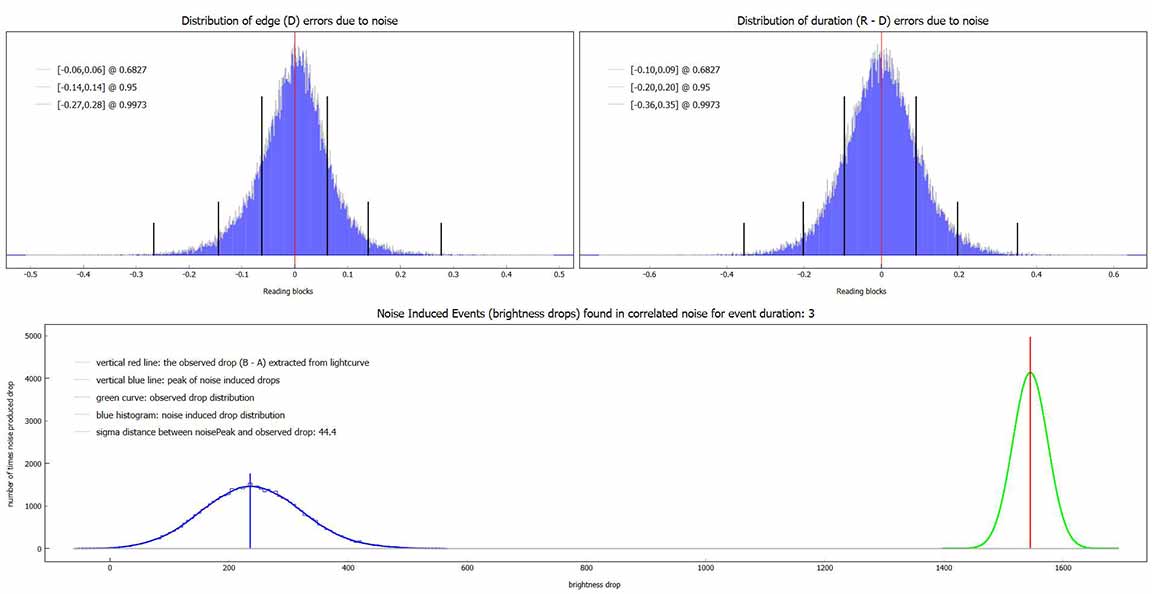
NIE test: 44.4 sigma
magDrop report: percentDrop: 86.4 magDrop: 2.168 +/- 0.287 (0.95 ci)
DNR: 10.35
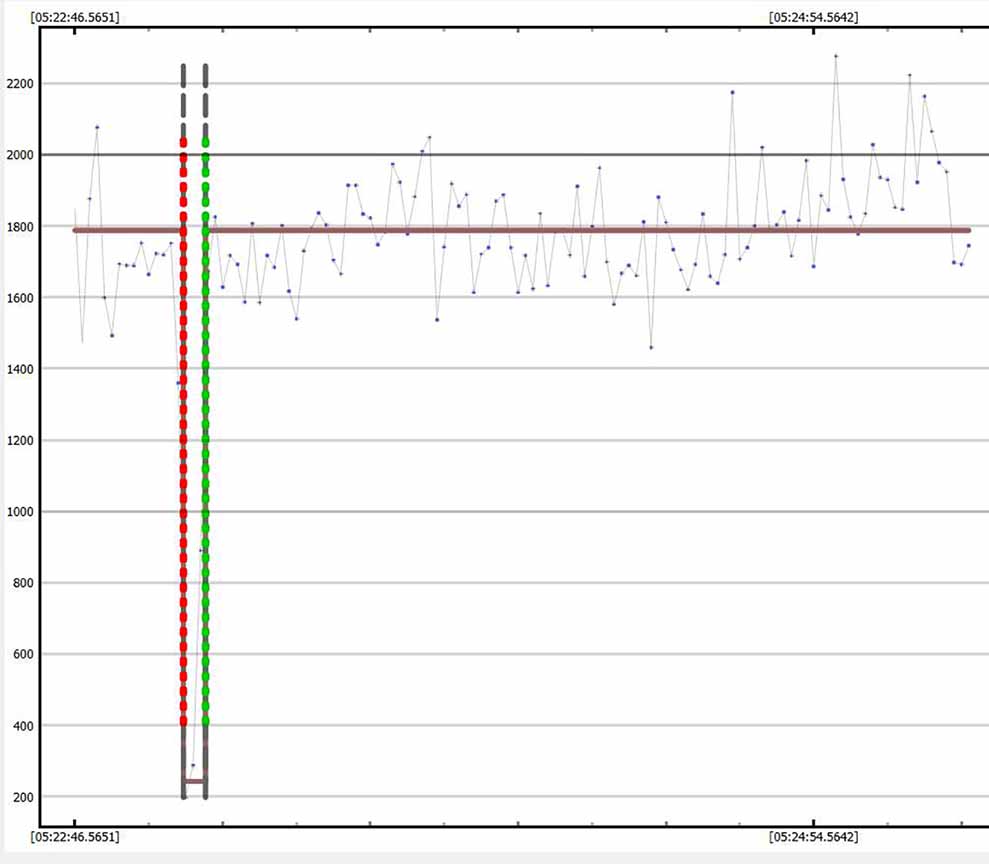
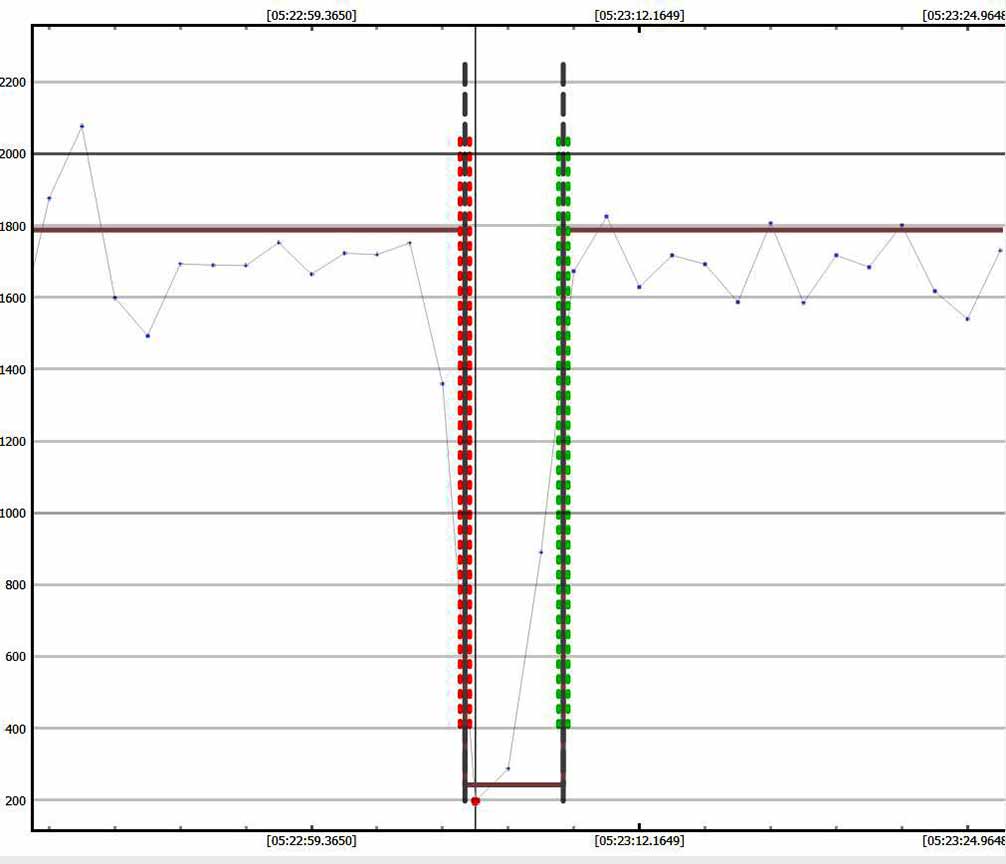
D time: [05:23:05.3556]
D: 0.6800 containment intervals: {+/- 0.0798} seconds
D: 0.9500 containment intervals: {+/- 0.1848} seconds
D: 0.9973 containment intervals: {+/- 0.3544} seconds
R time: [05:23:09.1884]
R: 0.6800 containment intervals: {+/- 0.0798} seconds
R: 0.9500 containment intervals: {+/- 0.1848} seconds
R: 0.9973 containment intervals: {+/- 0.3544} seconds
Duration (R - D): 3.8327 seconds
Duration: 0.6800 containment intervals: {+/- 0.1186} seconds
Duration: 0.9500 containment intervals: {+/- 0.2552} seconds
Duration: 0.9973 containment intervals: {+/- 0.4524} seconds
 |
 |
 |
 |
 |
 |
I got a 3.7667s event for Finsen at the Berm, 16x. I used a small size 11 aperture in PyMovie because of the crowded field. I didn't get much better containment intervals than Rick, despite him using 64x and me 16x. How can his error bars be on the order of a tenth of a second when his sampling resolution is on the order of a second? He got a much higher DNR of 10.35, compared to my 3.18, and higher 44 sigma to my 17.2 but maybe that's expected when using a higher integration, the noise is integrated out.
RN: I agree. my timing accuracies seem strangely higher than Kirk's and than I think is reasonable given the data. One reason might also be that I had saturated pixels in my target, suppressing some of the noise on the high end. It's not obvious on the light curve, but it makes sense that the effect would be to artificially suppress scatter. However - look at the duration of the event. Since this was such a wide path, our durations should not differ much and indeed they differ by only .1s, despite my 1.2s integration length. The software will interpolate well if the photometry values are accurate, so it's not to be assumed that the time accuracy couldn't be better than ~1/2 the integration time, as one might assume if you don't think about it much.
PyOTE NIE sigma distance = 17.2
magDrop report: percentDrop: 83.4 magDrop: 1.952 +/- 0.509 (0.95 ci)
DNR: 3.18
D time: [05:23:04.2798]
D: 0.6800 containment intervals: {+/- 0.0718} seconds
D: 0.9500 containment intervals: {+/- 0.2019} seconds
D: 0.9973 containment intervals: {+/- 0.4479} seconds
R time: [05:23:08.0465]
R: 0.6800 containment intervals: {+/- 0.0718} seconds
R: 0.9500 containment intervals: {+/- 0.2019} seconds
R: 0.9973 containment intervals: {+/- 0.4479} seconds
Duration (R - D): 3.7667 seconds
Duration: 0.6800 containment intervals: {+/- 0.1104} seconds
Duration: 0.9500 containment intervals: {+/- 0.2588} seconds
Duration: 0.9973 containment intervals: {+/- 0.5418} seconds